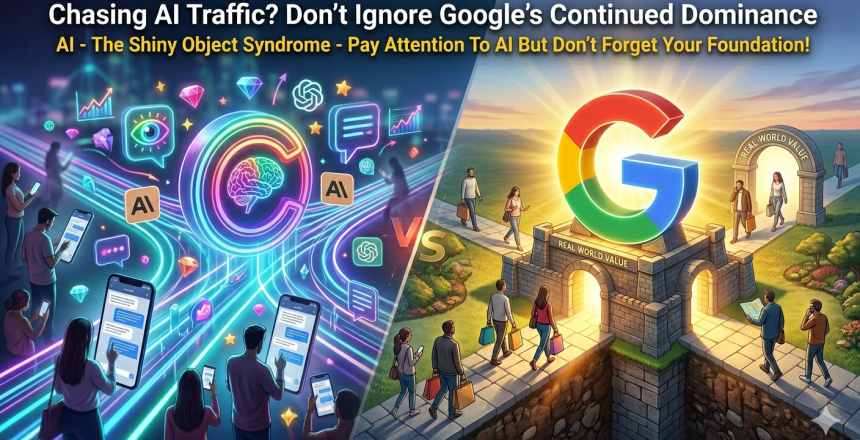
AI – The Shiny Object Syndrome – Pay Attention To AI But Don’t Forget Your Foundation!
In 2026, the tech scene is alive with talks about the future of search and content discovery. AI strategies like Answer Engine Optimization (AEO) and Generative Engine Optimization (GEO) are making headlines, offering new ways to connect with users. The effort to secure citations in large language models (LLMs) like ChatGPT, Claude, and Perplexity has sparked excitement, with many viewing these tools as the next big step in online visibility. It’s easy to get caught up in the appeal of being part of these emerging systems, where conversational AI seems to reshape user behavior and access to information. But while these innovations might provide opportunities for visibility and brand recognition, data consistently shows one clear fact: Google Search remains the most important channel for driving meaningful traffic and conversions. As businesses invest heavily in optimizing for AI, it’s important to ask whether they are overlooking the foundational elements that still drive the majority of online engagement and revenue.
The Reality Check: By the Numbers
Google’s role as a traffic powerhouse remains unshaken in 2026. Google processes a staggering 16.4 billion searches daily, in stark contrast to ChatGPT’s 2.5 billion daily prompts, of which only about one-third are searches for information. This vast disparity highlights the platform’s unmatched scale and relevance for driving users to websites. AI platforms currently account for less than 1% of global internet traffic, whereas organic search accounts for a massive 48.5%. The numbers underscore Google’s continued importance, even as conversational AI tools grow in popularity. While zero-click searches have increased due to AI-driven overviews, the volume of remaining clicks on Google vastly outperforms chatbot referrals. This is particularly evident in high-intent buying scenarios where users rely on Google to complete their purchasing journey. The consistency of these behaviors reinforces Google’s position as a critical source for traffic and revenue, eclipsing the early-stage impact of AI platforms.
The Interdependence: Google as the AI ‘Gatekeeper’
Google’s dominant role in search remains critical in the AI era. Maintaining about 90% of the market share in search, fluctuating between 89-93% through 2025. It acts as a main route for discovering information. About 75% of the sources in Google’s AI Overviews come from the top 10 organic search results, showing the clear connection between traditional SEO success and AI visibility. This indicates that to be included in AI-driven citations or overviews, a site must first establish itself as an authoritative source within Google’s ecosystem.
The E-E-A-T framework—Experience, Expertise, Authoritativeness, and Trustworthiness—continues to support Google’s search rankings and has become just as important for AI models as they identify and verify credible sources. If a website lacks strong rankings in traditional search, it nearly disappears from the algorithms that power LLM citations. By focusing on Google authority through proven SEO strategies, businesses can gain a dual benefit: improved rankings in organic search and greater AI-driven exposure, ensuring they stay relevant in the evolving digital landscape.
Buttoning Up for Google: The Fundamentals
To secure your spot in both Google’s search results and AI-driven overviews, your website’s foundation must be technically sound and user-focused. Start by optimizing Core Web Vitals —fast load times, interactivity, and visual stability—which are essential for ranking and user satisfaction. A seamless mobile experience is just as important as mobile continues to dominate search behavior. Beyond technical factors, focus on intent mapping to understand the underlying needs behind user searches. Create content that anticipates their next question or solves their next challenge, moving beyond simple keyword targeting. Structured data is another vital element. Use Schema markup to give search engines context, boosting your visibility in traditional results such as Rich Snippets and helping AI models interpret and display your content more effectively. These foundational steps position your site as a credible and valuable source, helping you compete in an evolving digital landscape. By concentrating on these core elements, you make sure your website isn’t just visible—it’s accessible, authoritative, and prepared to meet both search engine and user expectations.
The Balanced Strategy: A 2026 Roadmap
Balancing your approach between Google Search and AI optimization is essential for staying competitive in 2026. Using the 80/20 Rule, dedicate 80% of your resources to dominating Google Search, which remains the most dependable source of traffic and conversions, and 20% to developing AI-specific strategies like AEO and GEO. AI visibility typically takes 3-6 months to gain significant traction, with momentum continuing beyond 12 months. Focus on creating content that offers true value, encouraging users to interact directly with your site rather than just reading a summary. Your content strategy should combine traditional SEO techniques to drive clicks and conversions with AI-driven optimization to boost brand awareness and authority. Understand that AI strategies take different amounts of time to show results and adjust your resources accordingly. A comprehensive approach like this ensures that, as your business adapts to the growing importance of AI in search, it continues to prioritize the proven effectiveness of Google Search as the foundation of online visibility and growth.
Maintain Your Foundation – Don’t Build On Sand!
Success in the ever-changing digital landscape depends on a strong foundation, not fleeting trends. While AI tools like ChatGPT and Claude present exciting opportunities, their influence remains secondary compared to the proven strength of Google Search. Companies that focus too much on AI optimization at the expense of traditional SEO risk missing out on traffic and conversions essential for sustainable growth. A strategy rooted in Google’s ecosystem offers stability and broad reach, setting you up for both short-term and long-term success. By prioritizing core SEO principles—such as technical performance and user-focused content—you keep your website visible and trustworthy in a competitive environment. AI can enhance your approach, but it shouldn’t define it. While digital tools and platforms may change, the principles of building authority, trust, and value for your audience stay the same. Focus on what works, and use innovation as a complementary tool—not a replacement—for your foundation.